Phone Number
+91 8111002343

Get Free Quote
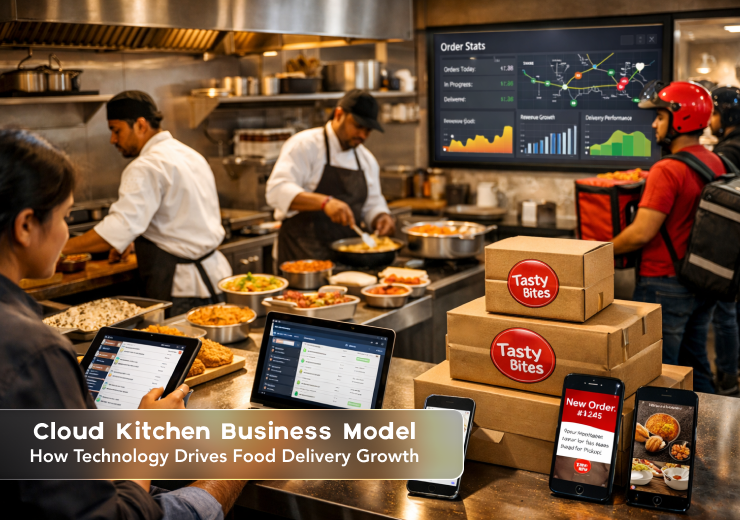
Introduction The cloud kitchen business model is transforming the food industry by enabling restaurants to operate without a physical dine-in space. With the rapid growth of online food delivery, this model has become one of the most profitable and scalable business opportunities. A cloud kitchen focuses entirely on food preparation and delivery, eliminating the need for expensive infrastructure and front-end operations. Combined with modern technology, the cloud kitchen business model helps entrepreneurs launch and grow food businesses faster than ever before. In this blog, we will explore how the cloud kitchen business model works, its benefits, required technology, and how it drives massive growth in the food delivery industry.
What is a Cloud Kitchen Business Model?
A cloud kitchen business model refers to a
delivery-only restaurant setup where food is prepared in a centralized kitchen
and delivered directly to customers through online platforms.
Unlike traditional restaurants, cloud kitchens do not offer
dine-in services. Instead, they rely on mobile apps, websites, and food
delivery platforms to receive and process orders.
Key Characteristics
How the Cloud Kitchen Business Model Works
The cloud kitchen business model operates through a
streamlined process:
This system reduces complexity and improves efficiency
compared to traditional restaurant models.
Types of Cloud Kitchen Business Models
1. Single Brand Cloud Kitchen
Operates one brand from a single kitchen.
2. Multi-Brand Cloud Kitchen
Multiple brands operate from the same kitchen, targeting
different audiences.
3. Aggregator-Based Cloud Kitchen
Relies on platforms like Swiggy and Zomato for orders.
4. Hybrid Cloud Kitchen
Uses both own app and aggregator platforms.
Role of Technology in Cloud Kitchen Business Model
Technology is the backbone of a successful cloud kitchen
business model. Without digital tools, managing orders and deliveries becomes
inefficient.
Essential Technologies
1. Online Ordering System
Allows customers to place orders easily.
2. Mobile App Development
Helps businesses build their own brand and customer base.
3. Order Management System
Centralizes all incoming orders from multiple platforms.
4. Delivery Management Software
Tracks deliveries and optimizes routes.
5. Inventory Management System
Reduces wastage and ensures stock availability.
6. Analytics and Reporting Tools
Provides insights into customer behavior and sales trends.
Benefits of Cloud Kitchen Business Model
1. Low Investment Cost
The cloud kitchen business model eliminates the need for
expensive interiors, seating arrangements, and prime location rentals.
2. High Scalability
Businesses can easily expand by opening multiple kitchens or
adding new brands without heavy investment.
3. Faster Setup
Compared to traditional restaurants, cloud kitchens can be
launched quickly.
4. Increased Profit Margins
Lower operational costs lead to higher profitability.
5. Data-Driven Decisions
With digital tools, businesses can track performance and
optimize operations.
6. Flexibility in Menu
Cloud kitchens can quickly adapt menus based on demand and
trends.
Challenges in Cloud Kitchen Business Model
While the cloud kitchen business model offers many
advantages, it also comes with challenges:
However, these challenges can be managed with the right
strategy and technology.
Why Cloud Kitchen Business Model is Growing Rapidly
The rise of food delivery apps and changing consumer
behavior have fueled the growth of cloud kitchens.
Key Growth Drivers
The cloud kitchen business model aligns perfectly with these
trends, making it a future-ready business.
Cloud Kitchen vs Traditional Restaurant
|
Feature |
Cloud Kitchen |
Traditional Restaurant |
|
Investment |
Low |
High |
|
Space |
Small |
Large |
|
Staff |
Limited |
More |
|
Scalability |
High |
Limited |
|
Revenue Channels |
Online |
Dine-in + Online |
How to Start a Cloud Kitchen Business
Step 1: Choose a Business Model
Decide whether to run a single brand or multiple brands.
Step 2: Select Location
Choose a location optimized for delivery.
Step 3: Build Technology Infrastructure
Invest in ordering, delivery, and management systems.
Step 4: Partner with Delivery Platforms
List your business on Swiggy, Zomato, etc.
Step 5: Launch Your Own App
Build brand identity and reduce dependency.
Step 6: Focus on Marketing
Use digital marketing to attract customers.
Importance of Having Your Own Food Delivery App
While aggregators provide visibility, having your own app
gives better control.
Benefits
How Gladxe Helps Build Cloud Kitchen Solutions
Gladxe provides end-to-end solutions for cloud kitchen
businesses.
Our Services
We help businesses build scalable and efficient cloud
kitchen systems.
Future of Cloud Kitchen Business Model
The future of the cloud kitchen business model is highly
promising. With increasing demand for online food delivery, more businesses are
adopting this model to stay competitive.
Emerging trends include:
Conclusion
The cloud kitchen business model is redefining the
food industry by combining technology, efficiency, and scalability. It offers a
cost-effective and flexible solution for entrepreneurs looking to enter the
food delivery market.
With the right strategy and technology, businesses can
achieve rapid growth and long-term success.
CTA
Looking to launch your own cloud kitchen business model
with advanced technology?
Contact Gladxe today
and build your scalable food delivery solution.
Ready to elevate your brand and achieve exceptional results? Our team
of creative experts is here to turn your vision into reality.
ⓒCopyright 2026 Gladxe Software Pvt Ltd . All rights reserved


 05 Mar 2026