Phone Number
+91 8111002343

Get Free Quote
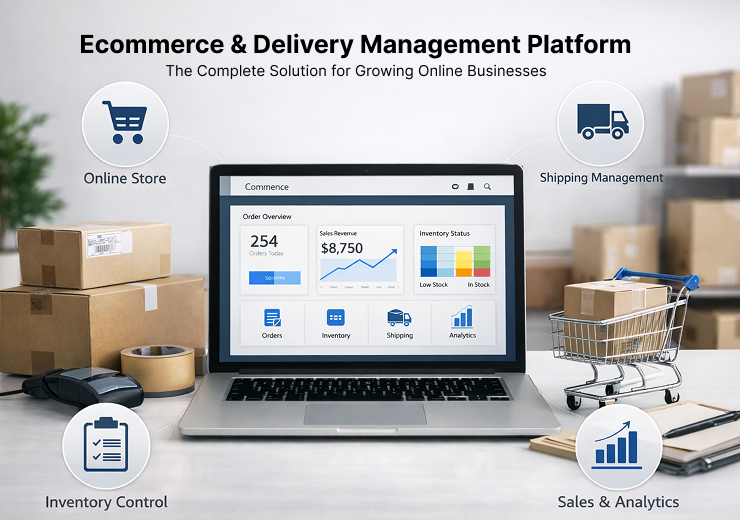
The ecommerce industry is growing rapidly, but managing online sales is no longer limited to just launching a website. Businesses must handle orders, payments, inventory, delivery logistics, and customer communication efficiently to scale successfully. This is where an ecommerce & delivery management platform becomes essential. Instead of using multiple disconnected tools, businesses can centralize operations in one unified system. In this article, we explore why an ecommerce platform software integrated with delivery management is critical for growing businesses.
What Is an Ecommerce & Delivery Management Platform?
An ecommerce & delivery management platform is a unified
system that helps businesses manage online sales, order processing, inventory,
payments, and route-based delivery operations.
A complete platform typically includes:
This centralized structure improves operational control and
scalability.
The Challenges of Managing Ecommerce Without an
Integrated System
Many businesses struggle because they use separate tools
for:
This leads to:
An integrated ecommerce SaaS platform solves these issues.
1. Centralized Order & Inventory Management
Order and inventory management is the backbone of ecommerce
operations.
An ecommerce platform software allows businesses to:
Centralized dashboards improve operational accuracy and
reduce errors.
2. Secure Payment Processing
Modern online stores must support multiple payment options.
An ecommerce & delivery management platform supports:
Reliable payment integration improves customer trust and
checkout efficiency.
3. Route-Based Delivery Management
Delivery is one of the most complex aspects of ecommerce.
Route-based delivery management enables businesses to:
This ensures faster order fulfillment and improved customer
satisfaction.
4. Integrated Customer & Delivery Mobile Apps
A scalable ecommerce platform software includes:
Delivery partners can update order status instantly, while
customers can monitor their orders seamlessly.
5. Data-Driven Decision Making with Reports &
Analytics
Growth depends on insights.
An ecommerce & delivery management platform provides:
With accurate analytics, businesses can make informed
expansion decisions.
6. Scalability for Growing Businesses
As order volume increases, manual systems fail.
A scalable ecommerce SaaS platform enables:
Technology ensures smooth growth without operational
breakdown.
7. Improved Customer Experience
Customers expect:
An integrated online store management system improves every
stage of the customer journey.
8. Reduced Operational Costs
By optimizing delivery routes and automating workflows,
businesses can:
Automation directly impacts long-term profitability.
Conclusion
Running an ecommerce business today requires more than just
a website. Businesses must integrate order management, inventory tracking,
secure payments, and route-based delivery into one cohesive system.
An ecommerce & delivery management platform provides the
foundation for scalable growth, operational efficiency, and improved customer
experience.
Investing in the right ecommerce platform software is a
strategic decision that enables businesses to expand confidently and compete
effectively in the digital marketplace.
Ready to elevate your brand and achieve exceptional results? Our team
of creative experts is here to turn your vision into reality.
ⓒCopyright 2026 Gladxe Software Pvt Ltd . All rights reserved


 08 Feb 2025