Phone Number
+91 8111002343

Get Free Quote
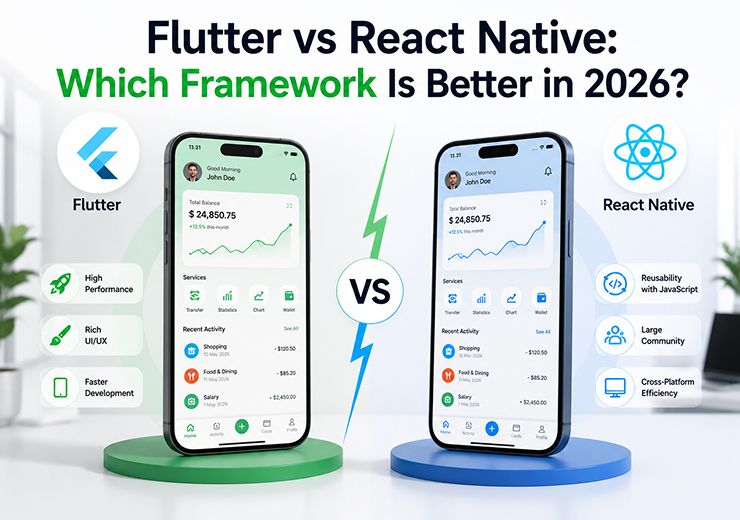
Mobile applications have become essential for businesses looking to improve customer engagement, increase revenue, and strengthen their digital presence. However, one of the biggest decisions businesses face before starting a mobile app project is choosing the right development framework.
When it comes to cross-platform mobile app development, two frameworks dominate the market:
· Flutter
· React Native
Both frameworks allow developers to build applications for Android and iOS using a single codebase, reducing development time and cost.
But which framework is better in 2026?
The answer depends on your business goals, app requirements, budget, scalability needs, and long-term vision.
In this blog, we'll compare Flutter and React Native in detail to help businesses choose the right framework for their next mobile application.
What is Flutter?
Flutter is an open-source UI framework developed by Google.
It allows developers to create mobile, web, and desktop applications using a single codebase.
Flutter uses the Dart programming language and comes with its own rendering engine, providing complete control over UI design.
Key Features of Flutter
· Single codebase
· Fast development
· Beautiful UI components
· High performance
· Strong Google support
· Cross-platform compatibility
Flutter has become one of the most popular frameworks for modern mobile application development.
What is React Native?
React Native is an open-source framework developed by Meta (Facebook).
It enables developers to build Android and iOS applications using JavaScript and React.
React Native uses native components, making it easier for web developers familiar with React to transition into mobile app development.
Key Features of React Native
· JavaScript-based development
· Native component rendering
· Strong community support
· Faster development
· Reusable code
· Large ecosystem
React Native remains one of the most widely used frameworks for cross-platform development.
Flutter vs React Native: Detailed Comparison
1. Performance
Flutter
Flutter compiles directly into native ARM code.
Benefits include:
· Faster performance
· Smooth animations
· Better rendering
· Reduced UI lag
Because Flutter uses its own rendering engine, performance is often closer to native applications.
React Native
React Native uses a JavaScript bridge to communicate with native components.
Although performance is excellent for most applications, complex animations and high-performance applications may experience slight delays.
Winner
�� Flutter
For performance-intensive applications, Flutter generally performs better.
2. User Interface (UI)
Flutter
Flutter provides complete control over UI design.
Advantages include:
· Rich widget library
· Consistent UI across platforms
· Advanced customization
· Beautiful animations
Developers can create highly modern and visually appealing interfaces.
React Native
React Native relies on native UI components.
Benefits include:
· Native look and feel
· Platform-specific UI support
However, achieving highly customized designs may require additional effort.
Winner
�� Flutter
Flutter offers greater flexibility for creating modern UI experiences.
3. Development Speed
Flutter
Flutter's Hot Reload feature allows developers to see changes instantly.
Benefits:
· Faster debugging
· Quicker UI development
· Improved productivity
React Native
React Native also offers fast refresh capabilities and benefits from JavaScript's popularity.
Large libraries and third-party packages speed up development.
Winner
�� Tie
Both frameworks provide excellent development speed.
4. Programming Language
Flutter
Uses Dart.
Advantages:
· Easy to learn
· High performance
· Strong tooling
Disadvantages:
· Smaller developer community
React Native
Uses JavaScript.
Advantages:
· Widely used language
· Large talent pool
· Easier hiring
Winner
�� React Native
JavaScript's popularity gives React Native an advantage.
5. Community Support
Flutter
Growing rapidly with strong Google support.
Thousands of packages available.
React Native
Larger and older community.
Extensive third-party libraries and resources.
Winner
�� React Native
React Native currently has a larger ecosystem.
6. App Maintenance
Flutter
Single codebase simplifies maintenance.
Fewer platform-specific issues.
React Native
Maintenance is straightforward but may require additional platform-specific adjustments.
Winner
�� Flutter
Flutter often requires less maintenance effort.
7. Development Cost
Businesses often choose cross-platform frameworks to reduce costs.
Flutter
Benefits:
· Single codebase
· Faster development
· Reduced maintenance
React Native
Similar advantages:
· Shared code
· Faster deployment
· Lower development costs
Winner
�� Tie
Both frameworks significantly reduce development expenses compared to native development.
8. Scalability
Flutter
Highly scalable architecture suitable for:
· Startups
· Enterprises
· Complex applications
React Native
Scalable but may require more optimization for large-scale projects.
Winner
�� Flutter
Flutter handles complex applications more effectively.
9. Popular Companies Using Flutter
Many global companies use Flutter.
Examples include:
· Google Pay
· Alibaba
· BMW
· eBay Motors
Flutter continues to gain enterprise adoption.
10. Popular Companies Using React Native
Major brands using React Native include:
· Facebook
· Instagram
· Shopify
· Discord
React Native remains a strong choice for large organizations.
Flutter vs React Native Comparison Table
Feature | Flutter | React Native |
Performance | Excellent | Very Good |
UI Design | Excellent | Good |
Development Speed | Excellent | Excellent |
Programming Language | Dart | JavaScript |
Community Support | Growing | Large |
Scalability | Excellent | Very Good |
Maintenance | Easy | Moderate |
Cost | Affordable | Affordable |
When Should You Choose Flutter?
Flutter is ideal if you need:
· High-performance applications
· Beautiful UI designs
· Complex animations
· Long-term scalability
· Consistent user experience
Best suited for:
· Ecommerce apps
· Delivery apps
· Healthcare apps
· SaaS applications
· Enterprise applications
When Should You Choose React Native?
React Native is ideal if you need:
· Faster hiring
· Existing React developers
· Native platform feel
· Quick MVP development
Best suited for:
· Social networking apps
· Content platforms
· Startup MVPs
· Community applications
Why Businesses Prefer Flutter in 2026
In recent years, Flutter has become the preferred choice for many businesses because of:
· Better performance
· Superior UI capabilities
· Easier maintenance
· Strong Google support
· Scalability
Many startups and enterprises are increasingly choosing Flutter for modern mobile applications.
Future of Cross-Platform Development
Cross-platform development continues to grow.
Key trends include:
AI Integration
Smart features powered by AI.
Faster App Development
Improved development tools and automation.
Better User Experiences
Advanced animations and personalization.
Unified Development
Applications running across mobile, web, desktop, and embedded devices.
Flutter and React Native will continue to lead this evolution.
How Gladxe Helps Businesses Build Mobile Apps
Gladxe develops high-performance mobile applications using Flutter and React Native.
Our Services
· Flutter App Development
· React Native Development
· Android App Development
· iOS App Development
· Ecommerce App Development
· SaaS Application Development
· Enterprise Mobile Solutions
We help businesses choose the right technology stack and build scalable applications that drive growth.
Conclusion
Both Flutter and React Native are excellent frameworks for cross-platform mobile app development.
React Native remains a strong choice for businesses seeking JavaScript-based development and rapid MVP creation.
However, Flutter offers better performance, superior UI flexibility, easier maintenance, and stronger scalability, making it the preferred framework for many businesses in 2026.
The right choice ultimately depends on your project requirements, budget, and long-term business goals.
By partnering with an experienced mobile app development company, businesses can select the best framework and build successful applications that deliver exceptional user experiences.
Frequently Asked Questions
Which is better, Flutter or React Native?
Flutter generally offers better performance and UI flexibility, while React Native provides stronger JavaScript ecosystem support.
Is Flutter faster than React Native?
Yes. Flutter often delivers better performance because it compiles directly into native code.
Which framework is cheaper?
Both frameworks reduce development costs by using a single codebase for Android and iOS.
Is Flutter suitable for enterprise applications?
Yes. Flutter is highly scalable and widely used for enterprise-grade applications.
Can React Native handle large applications?
Yes. React Native can support large applications but may require additional optimization for complex projects.
CTA
Looking for a trusted Flutter App Development Company in Coimbatore?
Gladxe develops high-performance Flutter and React Native applications tailored to your business goals. Contact our team today to build scalable, feature-rich mobile apps that drive growth and customer engagement.
Ready to elevate your brand and achieve exceptional results? Our team
of creative experts is here to turn your vision into reality.
ⓒCopyright 2026 Gladxe Software Pvt Ltd . All rights reserved


 11 Jul 2026