Phone Number
+91 8111002343

Get Free Quote
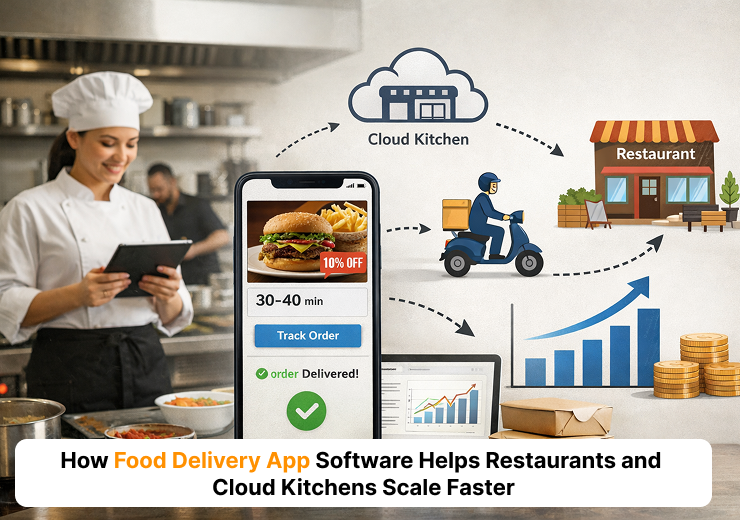
The food industry has rapidly shifted toward digital ordering and doorstep delivery. Restaurants and cloud kitchens that depend only on third-party platforms often struggle with high commissions, limited operational control, and reduced brand visibility. This is where food delivery app software becomes essential. A dedicated food delivery management software allows restaurants and cloud kitchens to manage online food ordering, streamline delivery operations, and scale efficiently without relying entirely on aggregators. This article explains how food delivery app software supports faster growth and long-term scalability.
What Is Food Delivery App Software?
Food delivery app software is a centralized platform that
enables restaurants and cloud kitchens to manage online food orders, delivery
routes, customer communication, and payment processing from one unified system.
A complete online food ordering system typically includes:
Instead of using separate tools, everything operates from
one scalable system.
Growth Challenges Faced by Restaurants and Cloud Kitchens
Food businesses commonly face:
Cloud kitchens depend heavily on digital orders. Without
proper cloud kitchen delivery software, scaling becomes costly and inefficient.
1. Direct Control Over Online Food Ordering
With food delivery app software, restaurants receive orders
directly through their own branded platform.
This provides:
An integrated online food ordering system ensures smooth
order flow into a centralized dashboard.
2. Route-Based Delivery Management Improves Efficiency
Delivery logistics directly impact customer satisfaction.
Route-based delivery management allows businesses to:
Food delivery management software helps minimize delays,
lower fuel costs, and maintain operational consistency.
For cloud kitchen delivery software models operating in
multiple areas, this feature is critical.
3. Real-Time Order Tracking Enhances Customer Trust
Modern customers expect transparency.
Food delivery app software provides:
This reduces support inquiries and improves customer
retention.
4. Stronger Brand Positioning for Cloud Kitchens
Cloud kitchens rely entirely on digital channels.
Using dedicated cloud kitchen delivery software allows:
Owning the customer experience strengthens brand identity
and long-term growth.
5. Subscription and Recurring Order Support
Many food businesses now offer recurring meal plans.
Advanced food delivery app software supports:
This builds predictable monthly revenue streams.
6. Centralized Admin Dashboard for Operational Control
A professional food delivery management software includes a
powerful admin panel to manage:
Centralized visibility helps restaurants make data-driven
decisions.
7. Lower Operational Costs
By reducing reliance on third-party delivery apps,
restaurants can:
This directly improves profit margins.
8. Scalable Infrastructure for Business Expansion
As order volumes grow, manual systems become inefficient.
Scalable food delivery app software allows businesses to:
Cloud kitchens aiming for multi-location growth require
reliable technology support.
9. Integrated Customer and Delivery Mobile Apps
Modern food delivery app software includes:
Delivery partners can view routes, update status, and
confirm deliveries in real time, improving operational clarity.
10. Improved Customer Retention Through Direct
Communication
Owning your online food ordering system allows:
Direct communication increases repeat orders and long-term
loyalty.
Conclusion
The food industry is becoming increasingly digital.
Restaurants and cloud kitchens that depend only on third-party aggregators
limit their growth potential.
By implementing food delivery app software, businesses can:
Investing in the right food delivery management software is
not just a technological upgrade—it is a growth strategy for long-term success.
Ready to elevate your brand and achieve exceptional results? Our team
of creative experts is here to turn your vision into reality.
ⓒCopyright 2026 Gladxe Software Pvt Ltd . All rights reserved


 01 Jan 2024